People, place and craftsmanship: behind the scenes at FEB 31ST in Bergamo
We spoke to SightCare’s Communications Manager Susie about her time in Italy:
There are some products that make much more sense once you know where they come from.
That was certainly the case when I joined three members of the award-winning Park Lane Opticians team for a trip to Bergamo and an opportunity to see behind the scenes at FEB 31ST.
The visit was Park Lane’s prize for being named Frame Styling Practice of the Year at the SightCare Awards in April, a category sponsored by FEB 31ST.
And while the trip promised an opportunity to learn how wooden frames are made, we came home understanding something much broader about the people, place and philosophy behind them.
A warm welcome to Bergamo
Our introduction began in Bergamo’s Città Alta, the beautiful walled old city perched above the modern city below.
FEB 31ST co-founder Stefano Sarti Cipriani collected me from the airport and whisked us up to meet the Park Lane team, who had already settled into Italian life with spritzes in one of the old city’s squares.
Dinner that evening was at one of Stefano’s favourite restaurants, based in a former prison and operating with a strong social purpose, including providing employment opportunities within the local community.
It was perhaps our first indication of something that would become much clearer the following day: people and community matter to FEB 31ST.
From wood to eyewear
The following morning we headed to FEB 31ST’s recently relocated production facility.
The reason for the move was interesting in itself. Stefano explained that being close to the people who make the frames was an important consideration when choosing the new location.
FEB 31ST’s craftspeople are, fundamentally, people who understand wood. That expertise has been brought into eyewear, rather than eyewear manufacturing simply adopting wood as another material.
Watching them work made the distinction clear.
The process starts with remarkably thin sheets of wood in an extraordinary choice of colours. Thirteen layers are carefully combined and bonded before being shaped under heat and pressure.
The resulting wooden “sandwich” then begins its journey towards becoming a frame. Machinery provides precision where it is needed, cutting the lens apertures and other components, but what struck us was how much skilled handwork follows.
Each job travels through the factory in its own box. Frames are filed and worked by hand, then painstakingly finished using different grades of abrasive material and an impressive collection of tools at the craftspeople’s workbenches.
Eventually, each reaches quality control before it can leave the factory.
For Park Lane’s Assistant Practice Manager and Frame Stylist Angharad Bramwell, that human element was the standout part of the experience.
“Seeing first-hand all the love that goes into the frames, and how much they truly care about what they make, was really special.”
Sustainability from the start
For Daily Operations Manager and Frame Stylist Melissa Oliver, one of the biggest takeaways was FEB31ST’s approach to sustainability.
Rather than producing large quantities of frames and then considering how to reduce the impact of that production, the principle is built into the process, including making frames in response to demand.
As Melissa put it: “Sustainability isn’t a by-product here. Often something is made first and then people look at what they can do afterwards to make it more sustainable. With FEB 31ST, it starts out that way and the frame is only made when it’s needed. That’s the beauty of it.”
Melissa’s observation gets to the heart of the FEB31ST philosophy: giving people complete freedom and choice to create truly bespoke eyewear, while having as little impact on the environment as possible and working towards zero waste.
There were smaller details that told the same story about the company’s priorities too.
Stefano showed us the tiny hinges used in the frames. When the components available to them weren’t strong enough to meet the standard they wanted, FEB 31ST had bespoke hinges produced instead, at considerably greater cost.
It is a tiny component most clients would probably never notice. But that, perhaps, is precisely the point.
Inspired by Bergamo
After the factory tour, a glass of Prosecco and a tantalising glimpse of some ideas in development, we returned to Città Alta.
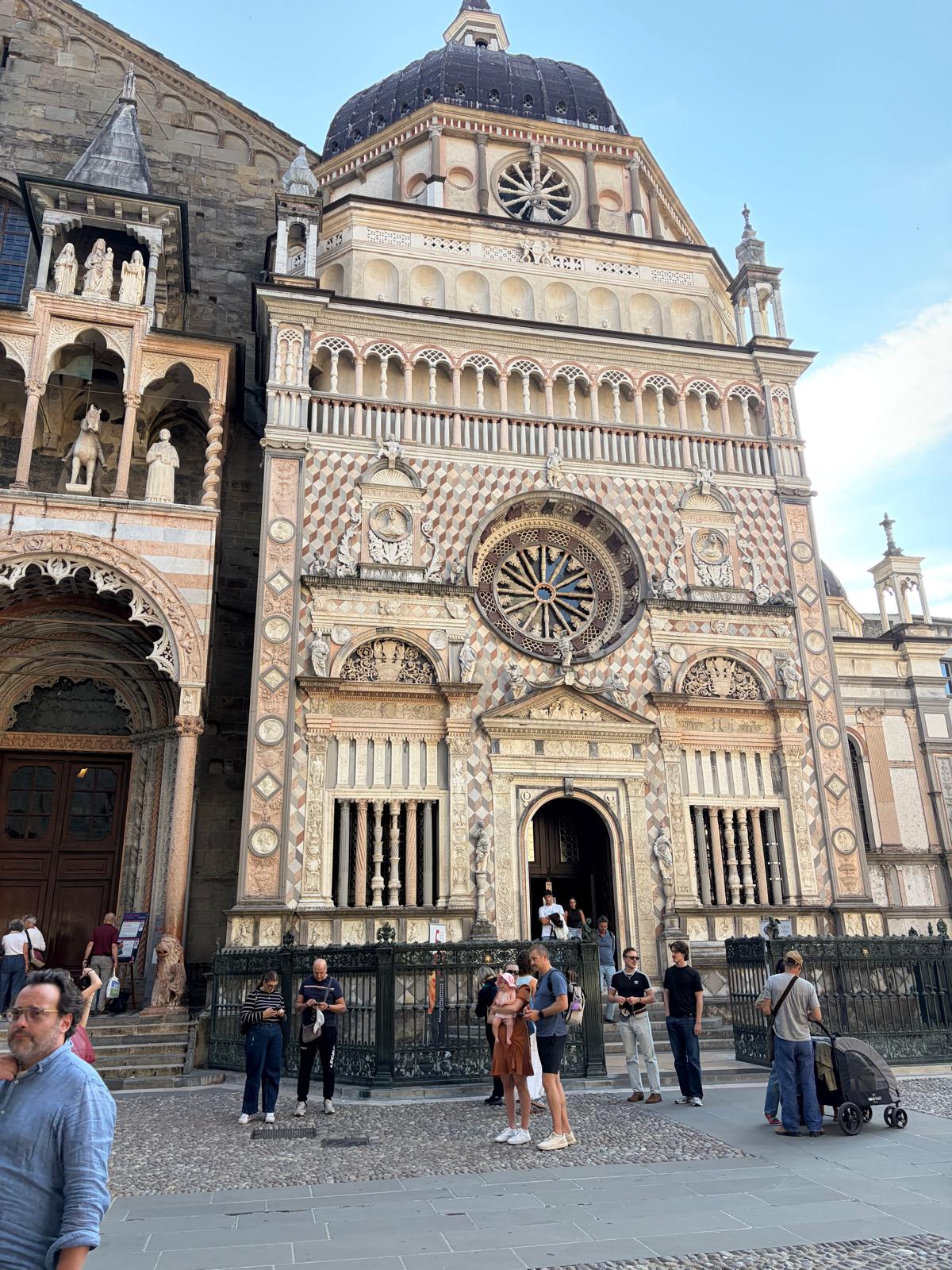
Walking through Piazza Duomo, Stefano pointed out the spectacular façade of the Cappella Colleoni, with its intricate geometric patterns and contrasting coloured stone.
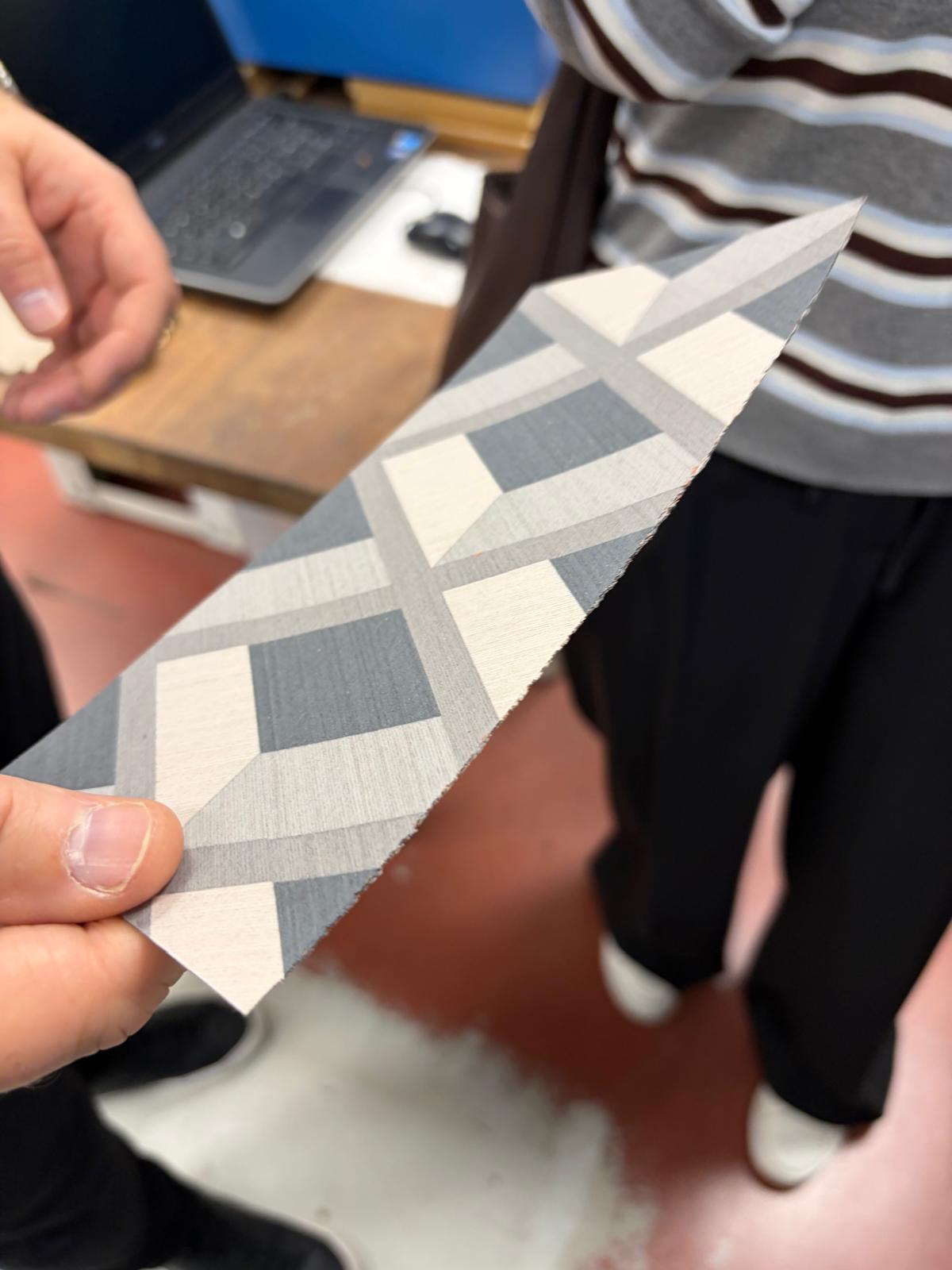
We had seen something remarkably familiar earlier that morning.
The architecture had directly inspired one of FEB 31ST’s wooden designs.
Suddenly the connection between product and place became tangible. The coloured layers of wood we had seen stacked in the factory, the patterns created from them and the extraordinary architecture surrounding us were all part of the same story.
FEB 31ST frames aren’t simply made in Bergamo. In some ways, they are of Bergamo.
Taking the story back to practice
For Park Lane, the trip offered something particularly valuable.
Their team already works closely with clients to find frames that suit not only their face, but their personality and individual style. Angharad has developed particular expertise in FEB 31ST’s handcrafted wooden frames, while Melissa brings her eye for design to her role as one of the practice’s key frame buyers.
Now, when they put a FEB 31ST frame into a client’s hands, they can talk about the people who made it, the layers of wood within it, the workbench where it was painstakingly finished and even the streets and buildings that helped inspire its design.
That is quite a story to be able to tell.
Our huge thanks go to Stefano Sarti Cipriani and Jason Robinson for their exceptional hospitality, and for giving us such a fascinating insight into the people and craftsmanship behind FEB 31ST.
And congratulations once again to Park Lane Opticians. We can’t think of a more fitting way to celebrate being SightCare’s Frame Styling Practice of the Year.